
Overview: how HemoCell works#
HemoCell couples two solvers to simulate suspensions of deformable cells:
a lattice Boltzmann method (LBM) solver for the surrounding fluid (blood plasma), provided by the Palabos library, and
a Lagrangian discrete-element representation of each cell, whose membrane is a triangulated surface mesh of material points.
The two are linked by the Immersed Boundary Method (IBM): the cells do not carve boundaries into the fluid grid. Instead, the membrane points feel the local fluid velocity and move with it, and in turn they spread their mechanical forces back onto the nearby fluid nodes. This two-way exchange happens through a compact interpolation kernel, so a membrane point interacts with the handful of fluid nodes within roughly two lattice cells of it.
The simulation loop#
A single HemoCell::iterate() call advances the coupled system by
one fluid time step. Conceptually each step does the following:
Interpolate the fluid velocity onto every membrane point.
Advect the membrane points with that velocity (the cells move and deform).
Evaluate the constitutive model: from the new shape of each cell, compute the membrane forces that resist stretching, area change, volume change, and bending (see The cell model).
Spread those membrane forces back onto the fluid nodes as a body force.
Collide and stream the fluid populations (the LBM update), which now feel the cell forces.
Several of these steps are expensive, so HemoCell does not necessarily run all of them every fluid time step — see time-scale separation.
The two central data structures#
The HemoCell object owns the whole simulation. Internally it
holds two things:
a single Palabos fluid lattice (
hemocell.lattice), the LBM grid; anda single cell-fields container (
hemocell.cellfields), which holds the particle field and every cell type you have added.
You add cell types (RBC, PLT, a custom type, …) to the cell-fields with
HemoCell::addCellType(), choosing both a mechanical model (the
constitutive behaviour) and a construction method (how the initial mesh is
built). The forces, interactions, load balancing, and MPI communication between
these structures are all managed by HemoCell so that, for most cases, you never
touch the parallelism directly.
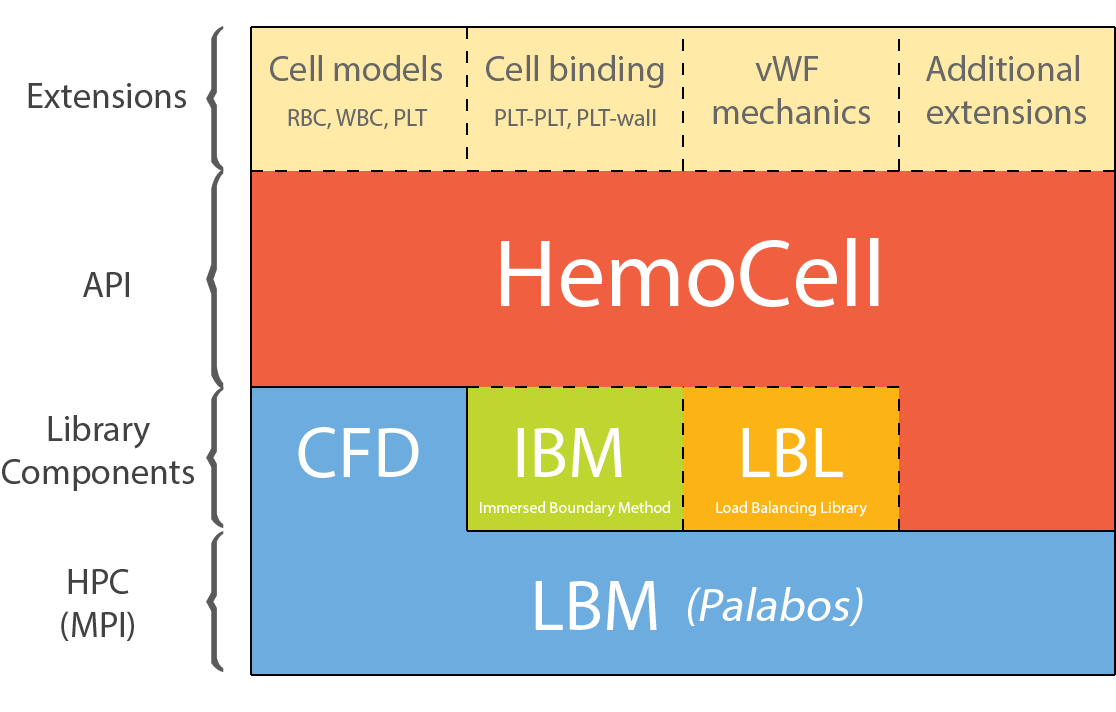
The major building blocks of a HemoCell simulation: the fluid (LBM) field, the cell models, and the interactions coupling them.#
Where to go next#
Units and scaling — how physical quantities map onto the simulation’s lattice units, and how to choose
dxanddt.The cell model — how a cell is discretised and what forces act on its membrane.
Parallelism and performance — how a simulation is split across processors.
Creating your own HemoCell Case — put these ideas together into a runnable case.